.png?width=12000&height=2033&name=WeberKnappLogo_white%20(1).png "WeberKnappLogo_white (1)")
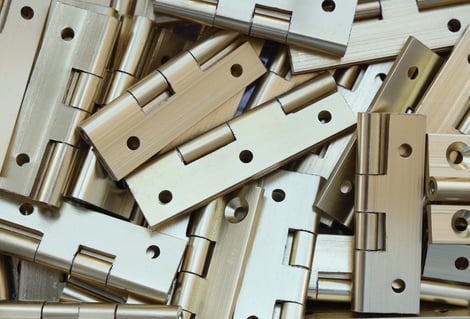
Hinges look simple… until you’re the one responsible for choosing one. If you’re early in your engineering career or new to sourcing mechanical components, it’s not always obvious how hinges actually work or what makes one design stronger than another.
Understanding the anatomy of a hinge makes the whole spec’ing process easier. You start to see why specific designs work, what questions to ask early on, and which details actually affect the way your product moves. And once you step into the world of heavy-duty industrial hinges, those details matter even more.
Below is a friendly crash course on the core hinge components and why they matter in real-world applications.
What Is a Mechanical Hinge?
A mechanical hinge is a simple concept at its core: it lets one part rotate relative to another. But in most real applications, a hinge does a lot more than just “open and close.” For heavy-duty industrial applications, hinges are engineered to components that manage load, control motion, and stay reliable under repeated use, often in demanding environments.
A Quick Breakdown
In industrial applications, a hinge also needs to:
- Support the weight of the moving part
- Keep the motion smooth and controlled
- Hold the assembly in proper alignment
- Handle repeated cycles without wearing out
In heavy-duty industrial applications, hinges are often engineered and tested for long-cycle life, ensuring consistent motion and alignment well beyond what standard hardware is designed to withstand.
When any of these fail, you feel it right away; movement gets sloppy, inconsistent, or stops working altogether.
Where Heavy-Duty Hinges Come In
Take those same motion requirements and place them in a tougher setting: higher loads, constant cycling, or equipment that needs to open safely and smoothly. That’s when you move into heavy-duty industrial hinge territory.
These hinges use stronger materials, tighter tolerances, and reinforced geometry so they hold up where standard hardware would wear out or deform. These are the kinds of conditions where hinge design becomes a critical part of overall system performance, not just a mounting detail.
The Basic Anatomy of a Heavy-Duty Hinge
Not all hinges are built the same way. While lighter-duty hinges often rely on flat leaves and simple barrels, heavy-duty industrial hinges are engineered differently to manage higher loads, longer cycle life, and controlled motion.
Housing
In heavy-duty hinges, the housing replaces what would traditionally be considered a “leaf.” Instead of thin plates, the housing is a structural component designed to support load, protect internal mechanisms, and maintain alignment over time.
The housing often:
- Provides rigidity under heavy or uneven loads
- Transfers force into the surrounding structure
- Encases internal components like springs or bearings
- Helps protect the hinge from wear, debris, or environmental exposure
Because of this, housing design plays a significant role in durability and long-term performance.
Pivot Nose
The pivot nose is the structural component that typically mounts to the door/lid/cover that you wish to move. It is typically more robust and engineered for precise alignment under load.
Key factors include:
- Pivot geometry that supports smooth, repeatable motion
- Reinforcement to resist deformation over thousands of cycles
- Tight tolerances that help reduce uneven wear
In heavy-duty applications, maintaining alignment at the pivot nose is critical to consistent motion and long service life.
Springs
Many heavy-duty industrial hinges incorporate internal springs to assist with motion control. These springs are a defining feature in designs like spring-assist and counterbalance hinges.
Depending on the application, springs may be used to:
- Reduce the effort required to lift or lower heavy panels
- Balance weight for safer, more ergonomic operation
- Control how quickly a panel opens or closes
- Improve usability across repeated cycles
Spring selection and placement are carefully engineered to match load, motion range, and cycle expectations.
Pin
The pin holds the hinge together and usually carries more load than most people realize. A larger pin diameter can handle greater force, and using hardened or corrosion-resistant materials helps the hinge last longer.
Retention features such as spun ends, staking, retaining rings, or welds keep the pin locked in place so it doesn’t drift over time. If the pin is too small for the application, the hinge’s performance and life drop off quickly.
In heavy-duty applications, pin design also has to account for dynamic forces and fatigue over time, not just static load.
Bearings or Bushings
Not every hinge uses them, but many mechanical hinges include bearings or bushings to reduce friction.
They’re especially valuable when:
- The hinge cycles all day
- Loads are high
- Smooth, quiet motion is important (ergonomic lids, equipment doors, etc.)
For high-cycle industrial applications, bearings and bushings can significantly extend service life by reducing metal-to-metal contact and minimizing wear over time.
Mounting Features
Holes, slots, brackets, and other mounting details might seem minor, but they play a big role in how well the hinge performs. Even a small misalignment can create extra friction or cause the panel to sag, which often turns into a failure point down the road.
How Heavy-Duty Hinges Differ From Standard Hinges
Here’s a quick look at how industrial hinges level up from everyday ones:
| Feature | Standard Hinge | Heavy-Duty Industrial Hinge |
| Material Thickness | Light-moderate | Thicker-gauge, reinforced |
| Pin Strength | Basic loads | Larger diameter, stronger materials |
| Pivot Design | Simple | Longer, reinforced, tight-fit, larger |
| Cycle Life | Moderate | Built for higher cycle use |
| Environment | Indoor/light use | Extreme, corrosive, or high-impact |
| Custom Options | Limited | Often engineered to fit the application |
If your application carries significant weight, cycles constantly, or needs repeatable performance, this difference matters a lot.
Why Understanding Hinge Anatomy Actually Matters
Knowing the basics of hinge anatomy isn’t just helpful for conversations; it directly impacts how well your design works and how long it holds up in the field. For industrial environments, hinge anatomy directly affects operator safety, ergonomics, and ease of use, especially when heavy panels are involved.
Questions That Come Up Once You Know the Basics
After you get comfortable with hinge anatomy, you naturally start spotting the things that matter. For example:
- Is the pin sized for the actual load?
- Are the leaves going to stay rigid, or do they need more support?
- Would bearings help with the cycle life we’re trying to achieve?
- Is the pivot built for the angle and frequency of use?
- Would motion control, spring-assist, or counterbalance improve safety or usability?
Asking these early prevents you from discovering problems after the prototype stage.
What You’ll Notice Before It Becomes a Bigger Issue
Common issues that stem from misunderstanding hinge anatomy:
- Premature wear
- Pin bending
- Misalignment
- Excessive friction
- Sagging doors or lids
- Material incompatibility
Most hinge failures aren’t dramatic; they’re slow, frustrating performance declines that trace back to small design assumptions.
Common Types of Heavy-Duty Hinges
In industrial applications, hinges aren’t just chosen by shape or mounting style – they’re selected based on how much load they carry, how often they move, and how that motion needs to feel. Many heavy-duty hinges are engineered to control motion, improve safety, or reduce the effort required to open and close large panels or lids.
Counterbalance Hinges
Counterbalance hinges are designed to offset the weight of a lid or panel, making heavy components feel significantly lighter to the user. By balancing the load against gravity, these hinges allow panels to open smoothly and stay in position without slamming shut or requiring excessive force.
They’re often used in applications where safety, ergonomics, and controlled movement matter, such as equipment enclosures, access panels, and industrial lids that are opened frequently throughout the day.
Spring-Assist Hinges
Spring-assist hinges use an internal spring mechanism to help lift or control the movement of a panel. Compared to basic hinges, they reduce the effort required to open or close heavier components while still providing predictable, repeatable motion.
They’re commonly selected when designers need motion assistance but don’t require full counterbalance. Spring-assist hinges are especially useful for industrial panels, lids, and covers where improved usability and reduced operator strain are priorities.
Continuous (Piano) Hinges
Continuous hinges run the full length of a door or panel, distributing load evenly across the entire span. This design helps reduce stress at individual mounting points and improves alignment, especially for wider or heavier panels.
In industrial applications, continuous hinges are often paired with thicker materials or reinforced designs to handle higher loads and frequent use.
Separable Hinges
Separable hinges allow panels or doors to be removed quickly without tools, making them useful in applications that require regular access, cleaning, or maintenance.
They’re commonly used in industrial equipment, enclosures, and service panels where downtime needs to be minimized.
Adjustable & Specialty Industrial Hinges
Some heavy-duty hinges are designed with adjustability or specialized geometry to meet unique installation or alignment requirements. These designs allow engineers to fine-tune positioning, compensate for tolerances, or meet specific space constraints without redesigning the entire system.
While these hinge types may look different on the surface, they all rely on the same core anatomy. What sets heavy-duty industrial hinges apart is how those components are sized, reinforced, and engineered to manage load, motion, and long-term performance.
How Hinge Anatomy Helps You Improve Spec’ing
Understanding how a hinge is built makes the spec’ing process a lot more straightforward. Instead of trial-and-error, you can base decisions on how each component actually affects performance.
Choosing Materials With Confidence
Once you know what each part of the hinge is responsible for, it becomes easier to decide whether you need carbon steel, stainless steel, hardened alloys, or something more specialized.
Matching the Hinge to the Motion
A few practical questions help narrow down the right design:
- What range of motion does the application need?
- How often will the hinge cycle?
- What direction is the load coming from?
- Does the motion need to be functional or feel exceptionally smooth?
- Does the application require motion tuning, balance, or resistance control?
Avoiding Undersized Components
Two hinges may look similar on the outside, but performance can vary dramatically. Pay attention to things like:
- Hinge length
- Material thickness
- Pin diameter
- Bearing selection
Small changes in these areas can make a noticeable difference in durability and motion quality.
When an Off-the-Shelf Hinge Isn’t Enough
Most projects start with standard hinges, but some applications eventually push beyond what catalog hardware can handle. When that happens, you’re usually dealing with demands that go beyond “typical” use.
Common Reasons a Standard Hinge Falls Short
Here are some of the most common situations where a standard hinge starts running out of steam:
- Heavy lids, doors, or panels
- High cycle counts that create long-term wear
- Mounting layouts that don’t fit standard dimensions
- Safety or ergonomic requirements that change how the hinge needs to move
- Environments with heat, chemicals, moisture, or corrosion concerns
These situations don’t always require a fully custom hinge, but they do call for something more thoughtfully engineered than an off-the-shelf pick. In many cases, these challenges point toward motion-controlled, spring-assist, or counterbalance hinge solutions designed specifically for industrial use.
Where Custom Hinges Help
Custom hinge design lets you solve the exact motion challenge you’re facing, whether that’s smoother rotation, higher load capacity, or integrating a counterbalance hinge for low-effort lifting.
In heavy–duty industrial environments, this can mean integrating counterbalance, managing high-cycle life, or controlling motion to improve safety and usability.
Putting Hinge Anatomy Into Practice
Learning the anatomy of a hinge isn’t about memorizing parts; it’s about understanding how those parts work together so you can design better, ask sharper questions, and avoid surprises in the field.
Even the smallest details in hinge construction can change how your product feels and performs, especially when you’re working with heavy-duty industrial hinges. If you’re ready to take the next step into motion design and ergonomics, there’s a lot more to explore.